

Your Legacy Prospects Aren’t Hiding, You’re Just Not Looking for Them the Right Way
This week Sigrid Penner (Focus Further Solutions) and I finished delivering a two-part webinar series titled Signals of Intent: How Donor Behaviour Can Reveal Legacy Potential. During the sessions we discussed how many fundraisers find legacy prospects the same way they’ve always found them: by running a donor through a filter, and another, and another, until only a few “perfect” prospects remain.
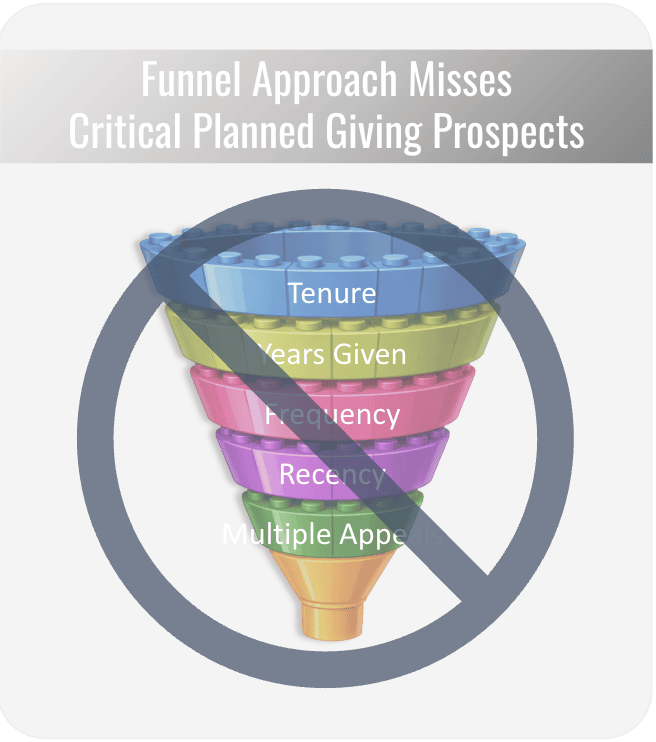
The problem is that this funnel approach leaves money on the table. Real money. The kind that changes organizations.
We see it constantly. A fundraiser runs their database through a 20+ year tenure filter, then an “active donor” check, then a “recurring gift” requirement. What’s left looks clean and manageable. But what got filtered out? The donor who’s been giving for eight years but is completely engaged. The volunteer who gives multiple times a year but isn’t flagged as a monthly donor. The woman who’s been a supporter for two decades but inconsistently so, yet is fully committed to the mission.
This is where the thinking needs to shift.
Signals, Not Screening
Legacy prospects aren’t discovered through elimination. They’re developed through understanding. And understanding starts with recognizing the signals they’re sending.
We’ve identified nine signals of intent that, when woven together, paint an accurate picture of a donor’s openness to a legacy conversation. Five are gift signals: tenure, frequency, recency, consistency of giving, and engagement with multiple appeals. Four are non-gift signals: participation across channels and campaigns, engagement with impact/program content, demographic data, and values-focused conversations.
Here’s the critical insight: the signals work in combination, not isolation.
A donor might score lower on tenure but higher on channel engagement, showing they’re invested across multiple touchpoints. Another might have modest giving history but be asking detailed questions about long-term sustainability. These aren’t weak prospects. They’re nuanced ones that traditional thinking would miss entirely.
Consider this real example I came across while working with a client a number of years ago. The organization received a universal gift in a will. The gift was over half a million Canadian dollars. The donor had made exactly three modest gifts in her entire history with the organization and it is unknown how she interacted with the organization (they were not tracking that at the time). She never married, had no children, and left 100 percent of her estate. By the funnel approach, she would have been dismissed as a prospect. If the organization would have used our layered signals approach, she may have been flagged as a prospect for further legacy engagement.
What Changes When You Think This Way
Moving from elimination to combination means you stop defining “prospect” so narrowly. You start asking better questions.
How many of your donors engage with you across multiple channels, not just through giving? Who’s reading your impact reports or watching your program videos? Who participates in your webinars or signs your petitions between gifts? These are signals. They’re showing you sustained interest and belief in your mission.
What about the conversations happening inside your organization? When a donor asks about appreciated securities, how staff are planning for changes in the future, or the long-term sustainability of a program, is anyone noting that? When a volunteer mentions your work aligns with values that have driven their work, is that being captured anywhere?
Most of the time, it isn’t. The information exists, but it’s scattered across conversations, email threads, different tech vendors, call notes, and people’s memories. It’s never centralized, never analyzed, never treated as intelligence.
This is where data changes everything.
From Data to Decisions
When you map these signals consistently across your donor file, you don’t just get a list. You get clarity.
You get permission to prioritize your finite resources on donors showing the strongest, most meaningful indicators of readiness. You stop calling people who aren’t ready. You stop missing people who are. You build a legacy pipeline that’s actually backed by evidence of intent.
I recently developed a legacy strategic and tactical plan. Sigrid and I analyzed their 119,000-donor file using gift and some non-gift signals. The analysis identified 286 perfect-score donors and over 700 additional prospects scoring 90 percent or higher. Rather than overwhelming them, we tiered the recommendations by first targeting those with a perfect score over the first year of launching the legacy program, then tackle those who scored 95 percent or higher in year two. Then, when resources grow, expand outward. This gave them a roadmap that was realistic, prioritized, and actually actionable based on their limited resources.
It also meant they could stop guessing. They knew exactly who to reach out to, why the data suggested they were good prospects, and what kind of conversation might resonate.
Where Most Organizations Get Stuck
The signals exist in your data right now. You’re just not pulling them together.
Your CRM might track giving frequency, but not whether donors engage with your newsletter. Your website analytics might show who watches your impact videos, but that information never makes it back to the fundraiser’s view of the donor. You capture conversations in call notes, but no one’s analyzing them for patterns or themes.
This fragmentation isn’t a problem of poor fundraisers or disorganized teams. It’s a structural problem. Most organizations built their databases to manage transactions, not to surface intent.
What’s Next
The signals are there. The question is whether you’re equipped to see them.
Your legacy prospects are already sending signals. Stop looking for them. Start listening for them.
Ready to uncover what your data is actually telling you?
Let’s talk about your donor file. We’ll assess your signals, identify your best legacy prospects, and build a realistic roadmap for moving them forward. Book a call with us to explore what this looks like for your organization.